What’s Hiding in Your Family’s Sausages?
September 25, 2026
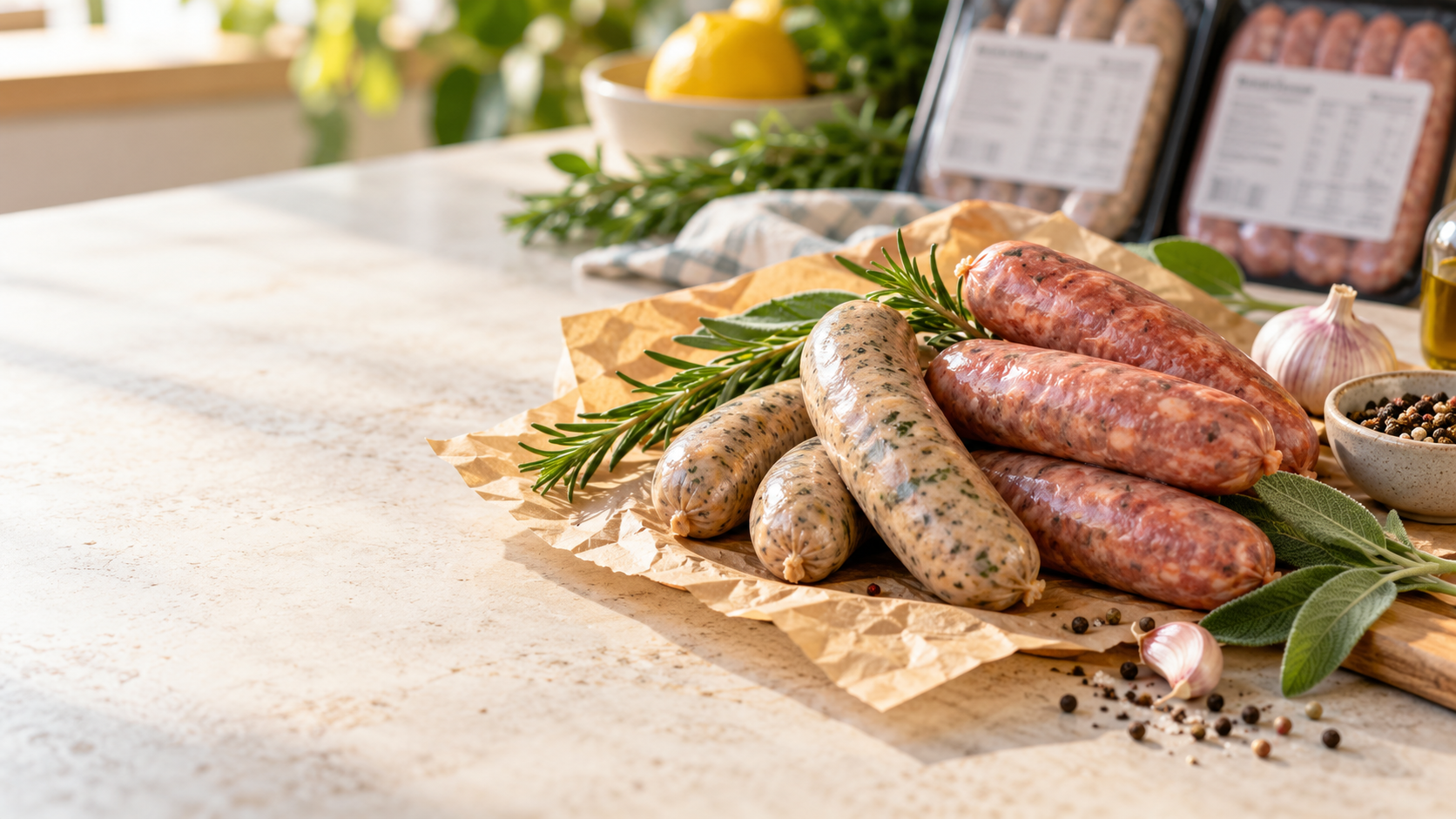
Sausages are a family favourite for good reason. They are quick, affordable, easy to cook and generally accepted by even the fussiest eaters. But turn over a few packets in the supermarket and you will quickly see that not all sausages are made the same way.
Some contain mostly meat, herbs and spices. Others come with long ingredient lists that include starches, sweeteners, flavours, colours, preservatives and other additives. Real Food Rating is not here to tell families they can never eat sausages. Our role is to look beyond the marketing and help shoppers understand what they are buying, compare the available options and make a more informed choice.
When we assess a product, we look at three key areas: how it is made, which additives it contains and how its nutritional profile compares. Here is how to apply that real-food lens to sausages.
SauSage Shopping Cheat Sheet:
1. Start with the meat percentage
The first thing we look at is how much meat the sausage actually contains. Under the Australia New Zealand Food Standards Code, a product sold as a sausage must contain at least 50 per cent fat-free meat flesh. That still leaves plenty of room for water, fat, cereal fillers and other ingredients.
As a practical guide, look for a clearly declared meat percentage and compare products side by side. From a Real Food Rating perspective, sausages with around 90 per cent meat or more are generally a better starting point, although the exact percentage will vary with the style of sausage and any genuine wholefood ingredients included.
Higher is not automatically perfect, but it is a useful starting point.
2. The meat in your sausage should be named and clearly listed
If you are buying a beef, chicken or pork sausage, the first ingredient should clearly say beef, chicken or pork. Be wary of vague terms such as “manufactured meat” or “meat including pork”. Under Australian food laws, “meat” can include a wide range of permitted species, from beef, pork, lamb and poultry to buffalo, camel, deer, goat, hare and rabbit. Choose sausages that clearly name every meat used and state its percentage. You should not have to guess what is in your sausage.
3. Look for a short, recognisable ingredient list
A simple sausage can be made from meat, fat, salt, herbs and spices in a casing. Small amounts of water and a binder may also be used to help with texture. If you see numbers and unrecognisable names, it’s more likely to be a heavily ultra-processed option. Breadcrumbs, rice flour, tapioca starch or potato starch, are not automatically harmful, but they can be used to stretch the meat and lower the cost of the product. If several starches, fibres and gums appear high on the list, you may be buying more filler and less meat than you expected. The Real Food Rating principle is simple: look for ingredients you recognise and understand, with meat doing most of the work.
4. Avoid artificial colours
Sausages do not need artificial colour to look like meat. Artificial colours can appear by name or number, including colours such as 110, 129. They add no nutritional value and are used only to change the product’s appearance. This is particularly worth checking in brightly coloured frankfurts, cocktail sausages and products heavily marketed to children. Choose sausages whose colour comes naturally from the meat, herbs and spices rather than synthetic dyes. Paprika, beetroot, turmeric and herbs can provide natural colour and flavour.
4. Check for preservatives, especially sulphites
Sulphites 220–228, particularly 223, are commonly used in fresh sausages to slow spoilage and preserve colour, but may trigger reactions in sulphite-sensitive people, especially those with asthma. Cured and processed sausages may also contain nitrites and nitrates 249–252. In certain conditions, these can form potentially harmful compounds and are classified by IARC as probably carcinogenic to humans. Choose preservative-free options where available. This is one reason regular processed-meat consumption is associated with an increased risk of bowel cancer.
5. Compare sodium per 100 grams
Sausages can be a significant source of sodium, even when they do not taste especially salty. The easiest way to compare brands is to ignore the manufacturer’s suggested serving size and use the per 100 g column in the nutrition information panel.
As a useful comparison point, the Australian Government’s voluntary reformulation target for sausages is no more than 540 mg sodium per 100 g. Look for options around or below this level where possible. If every option is higher, choose the lowest-sodium product with the simplest ingredient list. Remember that the rest of the meal matters too. Serve sausages with vegetables, salad, legumes or a wholefood carbohydrate rather than piling on other salty foods and sauces
6. Do not assume chicken, organic or gluten-free means healthier
Front-of-pack claims can create a health halo, but they do not tell you the whole story. A chicken sausage can still be high in sodium, fat, fillers and additives. An organic sausage may use better-quality meat but still contain plenty of salt. A gluten-free sausage may simply replace breadcrumbs with refined starches and gums.
These features may matter to your family, especially where allergies or dietary needs are involved, but always turn the packet over. Real Food Rating assesses what is actually inside the product, because the ingredient list and nutrition panel tell you far more than the marketing on the front.
The same applies to plant-based sausages. Some are made from recognisable foods such as legumes, vegetables, nuts and seeds. Others are highly formulated products containing protein isolates, refined oils, flavours, colours, gums and high levels of sodium. Judge them by the same principles: ingredient quality, degree of processing, additives and nutrition.
7. Choose quality over frequency
Sausages can be part of family life, but they do not need to be an everyday protein. Our advice is to choose a better-quality sausage less often and build the meal around plenty of whole foods. Rotate sausages with eggs, fish, chicken, lean meat, lentils, beans and other minimally processed proteins across the week. If your budget is tight, comparison still helps. The most expensive sausage isn’t always the best. Look at the meat percentage, ingredient list and sodium level, then choose the best option within your budget.
Our Top 3 OptionS:
- Cleavers Organic Hot Dogs
- Macro Organic Beef Sausages
- Butcher Crowd Beef Sausages
- Uncle SmallGoods Part Franks
A QuiCk SauSage-Shopping CheCkliSt
Before putting a packet in your trolley, ask:
1) Is meat the first ingredient?
2) Is the meat percentage clearly stated and preferably around 80 per cent or more?
3) Is the ingredient list short and recognisable?
4) Is it free from artificial colours?
5) Can I choose an option without sulphite preservatives such as 220 to 228 or 249-252.
6) How does the sodium compare per 100 g? Can I find one around or below 540 mg?
7) Are wholefood ingredients doing the work, rather than multiple starches, gums, flavours and fillers?
A final safety note for families
Because sausages are made from minced meat, cook them thoroughly all the way through. The NSW Food Authority recommends an internal temperature of 71°C for sausages.
Whole or coin-shaped pieces can also be a choking hazard for young children. Remove the skin if it is tough and cut cylindrical foods such as sausages lengthways, then into quarters, rather than serving round slices.
The bottom line
Real Food Rating is not about fearing food or banning sausages from the family table. It is about giving families clearer information and showing them what to look for.
Choose a product with a high proportion of clearly identified meat, a short ingredient list, no artificial colours, minimal unnecessary additives and a lower sodium level. Then serve it as part of a balanced meal rich in vegetables and other whole foods. Small changes at the supermarket add up. Better choices also send manufacturers a clear message: families want honest, simple food made from ingredients they can recognise.
That is exactly why Real Food Rating evaluates the whole product, not just a single nutrient or a front-of-pack claim.
The Real Food Rating is Australia’s only independent food rating system designed by a paediatric nutritionist. Brands can’t manipulate their ratings. Just honest ratings based on real nutrition science.