The Government Responded to Our Petition — Here’s What It Really Means for Aussie Families
The government has admitted the Health Star Rating system isn’t working, but they plan to make it mandatory anyway, without fixing the algorithm that misleads families into thinking ultra-processed foods are healthy choices. After more than 14,389 parents signed our PETITION calling for urgent reform of Australia’s Health Star Rating (HSR) system, I wrote to the Minister for Health and Ageing, the Hon Mark Butler MP, asking for transparency, accountability, and change.
I received the government’s official response on October 1st, while I was overseas, and took time to reflect on what it truly meant — and what should happen next. While I’m grateful to have been heard, what’s most concerning is what this letter doesn’t say — and how it confirms that Australian families are still being left without the clear, honest labelling they deserve
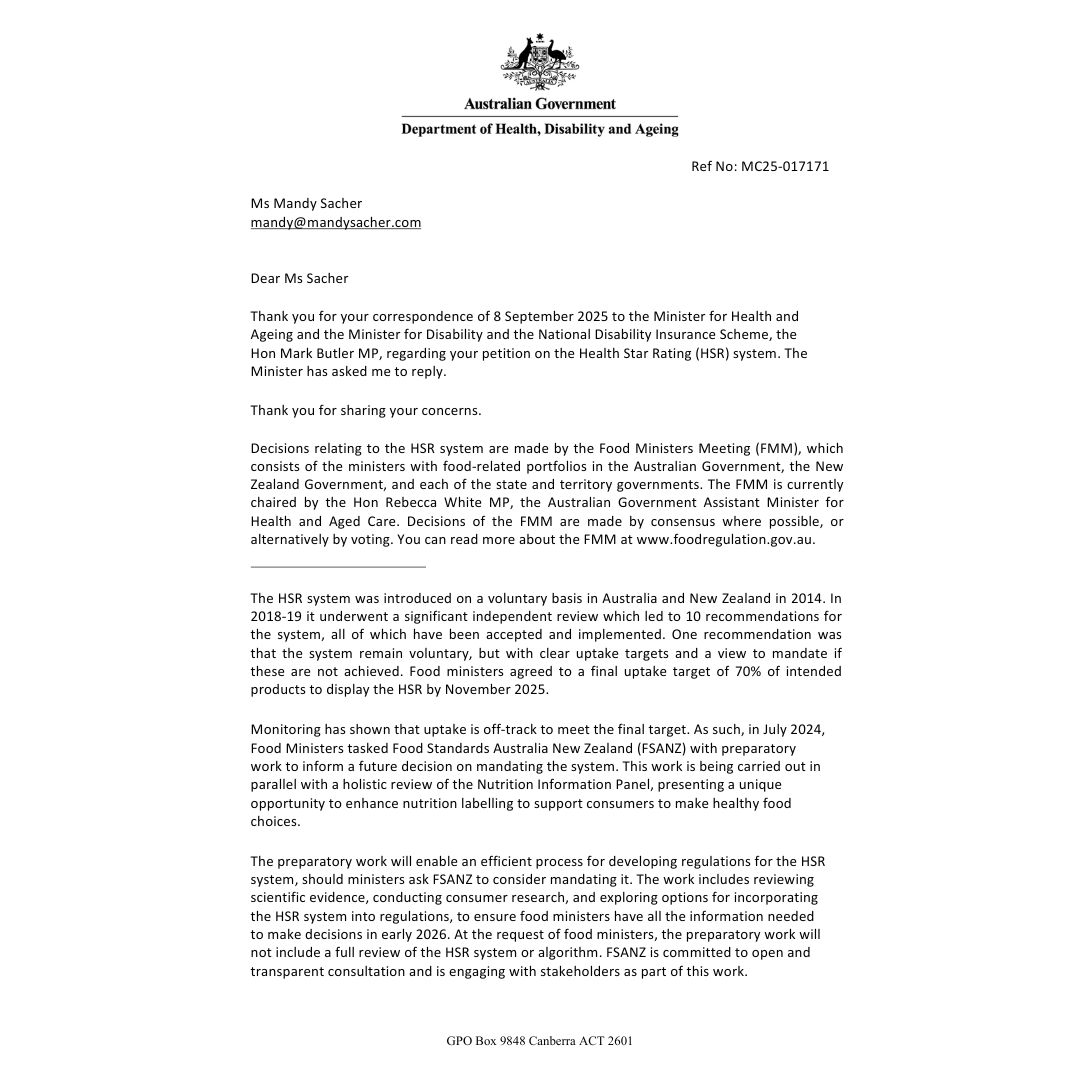
Below, I’ve shared the response in full — followed by a plain-English breakdown of what it really means for parents.
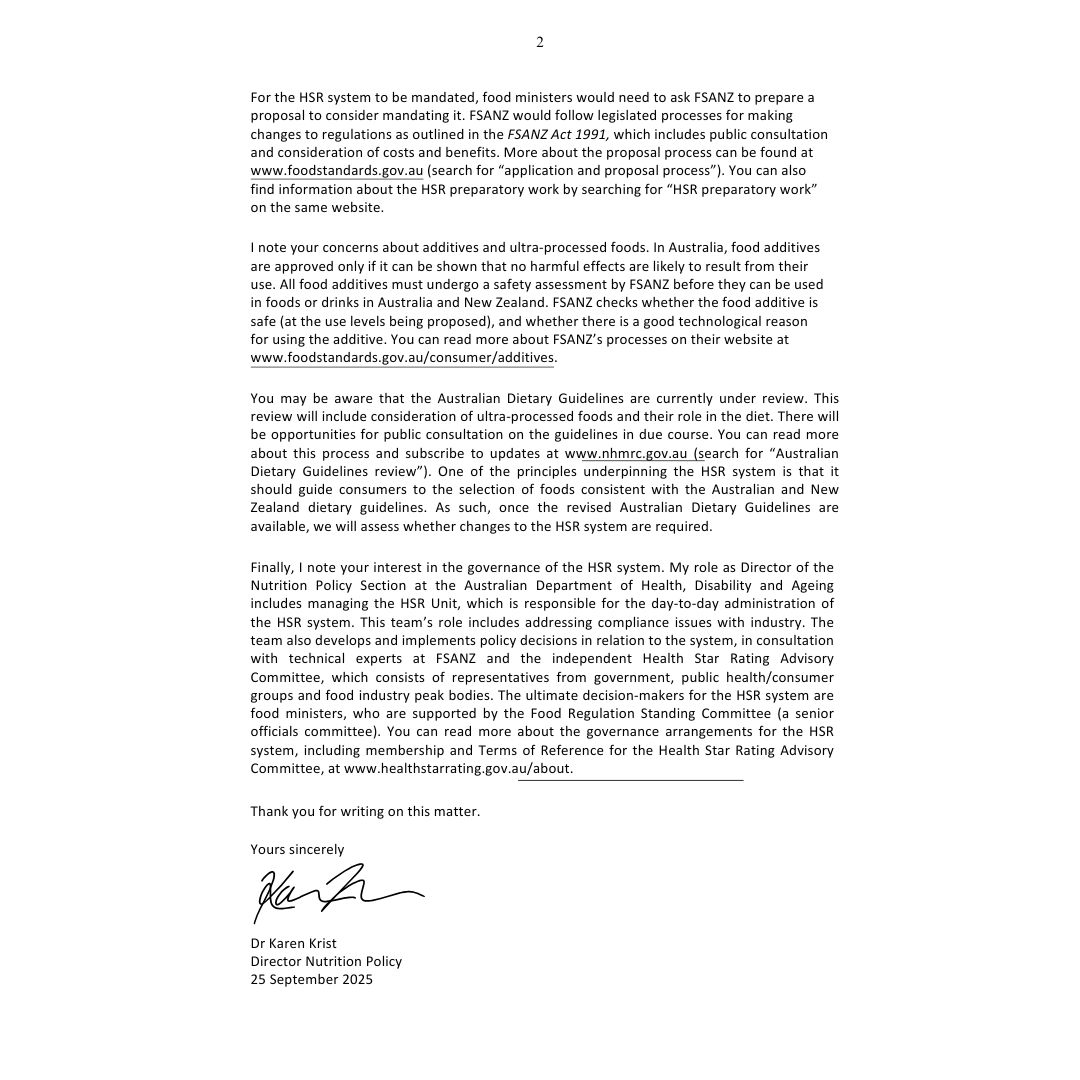
The OffiCial ReSponSe!
What ThiS MeanS in Plain EngliSh
This is my opinion and interpretation of the letter received.
1. They Admit the SyStem ISn’t Working
Letter:
“Monitoring has shown that uptake is off-track to meet the final target.”
The government acknowledges that the voluntary Health Star Rating scheme hasn’t met its own targets. Yet instead of acting urgently to fix what’s clearly broken, they’re simply discussing whether to make it mandatory — without addressing why it’s misleading and ineffective in the first place. Surely, if it were trustworthy and making an impact, there would be a strong community callout for it to be mandated.
2. The Algorithm Will Stay the Same
Perhaps the most worrying line:
“At the request of food ministers, the preparatory work will not include a full review of the HSR system or algorithm.”
This single line says everything parents need to know. It means the same algorithm that gives Milo Snack Bars, Up & Go, and sugary cereals up to four stars will stay in place, even as the government moves to make the system mandatory. Rather than fixing what’s broken, policymakers plan to lock it in.
For families, this means the HSR will continue to reward ultra-processed foods that meet narrow nutrient targets (such as added fibre or protein) while penalising whole, minimally processed foods that fall outside the formula.
How can a flawed algorithm be Australia’s primary food-rating tool? At best, this is complacency. At worst, it’s negligence because parents deserve a system that reflects ingredient quality, not one that lets processed snacks appear as healthy as real food.
3. AdditiveS Are Still Being ASSeSSed by Outdated StandardS
Letter:
“In Australia, food additives are approved only if it can be shown that no harmful effects are likely… FSANZ checks whether the food additive is safe… and whether there is a good technological reason for using the additive.”
“Technological reason” means shelf life, colour, texture or manufacturing convenience — not child health. Current checks don’t account for cumulative exposure, microbiome disruption, or effects on developing brains — the very issues parents observe first-hand. Below are some of the research studies our government fails to acknowledge, yet continues to endorse through a rating system that awards high stars to foods laden with additives.
– Food additives and gut health: Common emulsifiers, sweeteners, preservatives and artificial colourants can alter gut microbiota, weaken the intestinal barrier and increase inflammation.
– Synthetic food dyes and behaviour: Studies, including the 2007 Southampton study published in The Lancet, link artificial colours with irritability, hyperactivity and poor sleep patterns in children — research that led to warning labels in the EU but not in Australia.
– FAO findings: The UN Food and Agriculture Organization has warned that current global risk assessments ignore microbiome impacts and real-world exposures in children.
– UPFs and the gut-brain axis: Research shows ultra-processed foods disrupt the microbiota–gut–brain connection, affecting immunity and behaviour.
– Children are not miniature adults: Their developing brains and organs make them far more vulnerable to additive mixtures than adult safety tests assume.
In short, while the government’s letter suggests that regulatory approval equals safety, the science reveals that the model is outdated — not attuned to children’s vulnerabilities, nor designed to capture the cumulative and synergistic effects of additives and processing.
4. Ultra-ProceSSed FoodS Still Get a “Healthy” Halo
Letter:
“You may be aware that the Australian Dietary Guidelines are currently under review. This review will include consideration of ultra-processed foods and their role in the diet… Once the revised Australian Dietary Guidelines are available, we will assess whether changes to the HSR system are required.”
The government says ultra-processed foods will be addressed once the new Australian Dietary Guidelines are released — but that review is still underway and years behind schedule.
The current guidelines date back to 2013, and new ones aren’t expected until 2026, leaving the Health Star Rating built on outdated science that ignores the harms of industrial processing and additives.
In the meantime, the system continues to reward ultra-processed foods — from sugary cereals to snack bars — with a “healthy” halo that misleads families.
A 2023 BMJ review of over 10 million people linked higher UPF intake to 32 health issues, including heart disease, cancer, type 2 diabetes, anxiety and depression.
Children are particularly at risk. Their developing brains and bodies are more sensitive to the refined oils, emulsifiers and synthetic additives that dominate these foods — yet the government keeps postponing reform.
At the heart of the Real Food Rating philosophy is a simple principle: when it comes to children, precaution must come before profit. Ultra-processed foods packed with additives should never be positioned as healthy choices — they belong in the “occasional” category, not the everyday lunchbox.
5. “ASSeSS Whether” — The Loophole for Delay
Letter:
“Once the revised Australian Dietary Guidelines are available, we will assess whether changes to the HSR system are required.”
This single phrase — “assess whether” — is one of the most concerning in the entire response. It doesn’t commit to fixing the algorithm once the new guidelines are published. It simply promises to assess whether changes might be needed, which could mean no changes at all. That’s not reform — it’s stalling. By 2026, the guidelines will be 13 years old. If the review process takes another two to three years, families could be waiting nearly 15 years between dietary updates and any meaningful change to the Health Star Rating system.
Parents don’t have that kind of time. Every year of delay means another generation of children learning to trust a label that tells them ultra-processed snacks are “healthy”.
6. InduStry Still HaS a SEat at the DeCiSion-Making Table
Letter:
“The team also develops and implements policy decisions in relation to the system, in consultation with technical experts at FSANZ and the independent Health Star Rating Advisory Committee, which consists of representatives from government, public health/consumer groups and food industry peak bodies.”
The letter confirms that food industry bodies sit on the advisory committee overseeing the Health Star system — a governance structure that raises serious questions about whose interests are being prioritized. This may help explain why reform has been so slow, even as evidence mounts that ultra-processed foods continue to earn high ratings despite their health impacts. While industry input may be valuable, the current structure creates an inherent tension between public health goals and commercial interests — particularly when it comes to rating the very products these companies produce.
7. One Small Opening: PUBLIC CONSULTATION IN 2026
The Department has confirmed there will be public consultation before finalising the mandate, likely in early 2026. This is the moment parents need to unite. We must demand the algorithm be fixed before it’s made law — not years later, and not under pressure from the food industry.”
8. “What We’re ASking For”
This isn’t complicated. Australian families deserve a food labelling system that:
✓ Reviews the algorithm NOW — not after it’s mandated, not after the dietary guidelines are updated, but before any further policy decisions are made
✓ Adopts a precautionary approach for children — when it comes to additives, ultra-processed foods and developing bodies, we should err on the side of caution
✓ Ensures transparency in governance — clear separation between those who make the rules and those who profit from them
✓ Updates standards in line with current science — including the growing body of research on ultra-processed foods, gut health, and cumulative additive exposure
✓ Implements an interim pause — do not mandate a broken system while these fundamental issues remain unresolved
These aren’t radical demands. They’re common sense. And they’re what every parent deserves when trying to feed their family well.
ConCluSion
I’ll be honest — I’m deeply disappointed. I had hoped this response would mark a turning point, a moment when our government acknowledged the urgency of protecting Australian families from misleading food labelling. Instead, what I’ve read is more delay, more bureaucracy, and more excuses.
This is not about fear-mongering or pointing fingers. It’s about wanting what’s best for our children and for every Australian family trying to make healthy choices in a system stacked against them. When you strip away the politics, it’s really very simple: families deserve transparency, truth, and trust.
That’s why I created the Real Food Rating System — a science-based alternative that rates foods on whole ingredients, minimal processing, and nutritional value, not algorithms designed around outdated guidelines and industry interests. It’s not perfect, but it puts children’s health first. Instead of dismissing or defending the current system, perhaps policymakers could take the time to learn from one mother and a nutritionist’s attempt to make a positive change. Because I believe this movement — grounded in science, compassion and lived experience — can help shape the next generation of food policy in Australia.
And judging by the 14,389+ parents who’ve already joined this call, change is not only necessary — it’s inevitable.
What You Can Do:
- Email Minister Mark Butler and Minister Rebecca White: Mark.Butler.MP@aph.gov.au | Rebecca.White.MP@aph.cov.au
- Share this article to spread awareness
- Sign the petition
- Join the movement — because together, we can demand better for Australian families.
- Follow me on Instagram and share your voice – I want to hear what you think
Government letter reproduced under fair dealing provisions for purposes of criticism and review. © Commonwealth of Australia 2025
Coming Soon: The UnfuSSy EaterS Club
If you’re ready to build better food habits and avoid Ultraprocessed foods right from the start, my new book The Unfussy Eaters Club launches in March 2026.