The United States Just Did What Australia Won’t: Named Highly Processed Foods as the Problem.
The United States Just Did What Australia Won’t: Named Ultra-Processed Food as the Problem. While America rewrites its nutrition playbook, Australian families are still navigating supermarkets with guidelines from 2013.
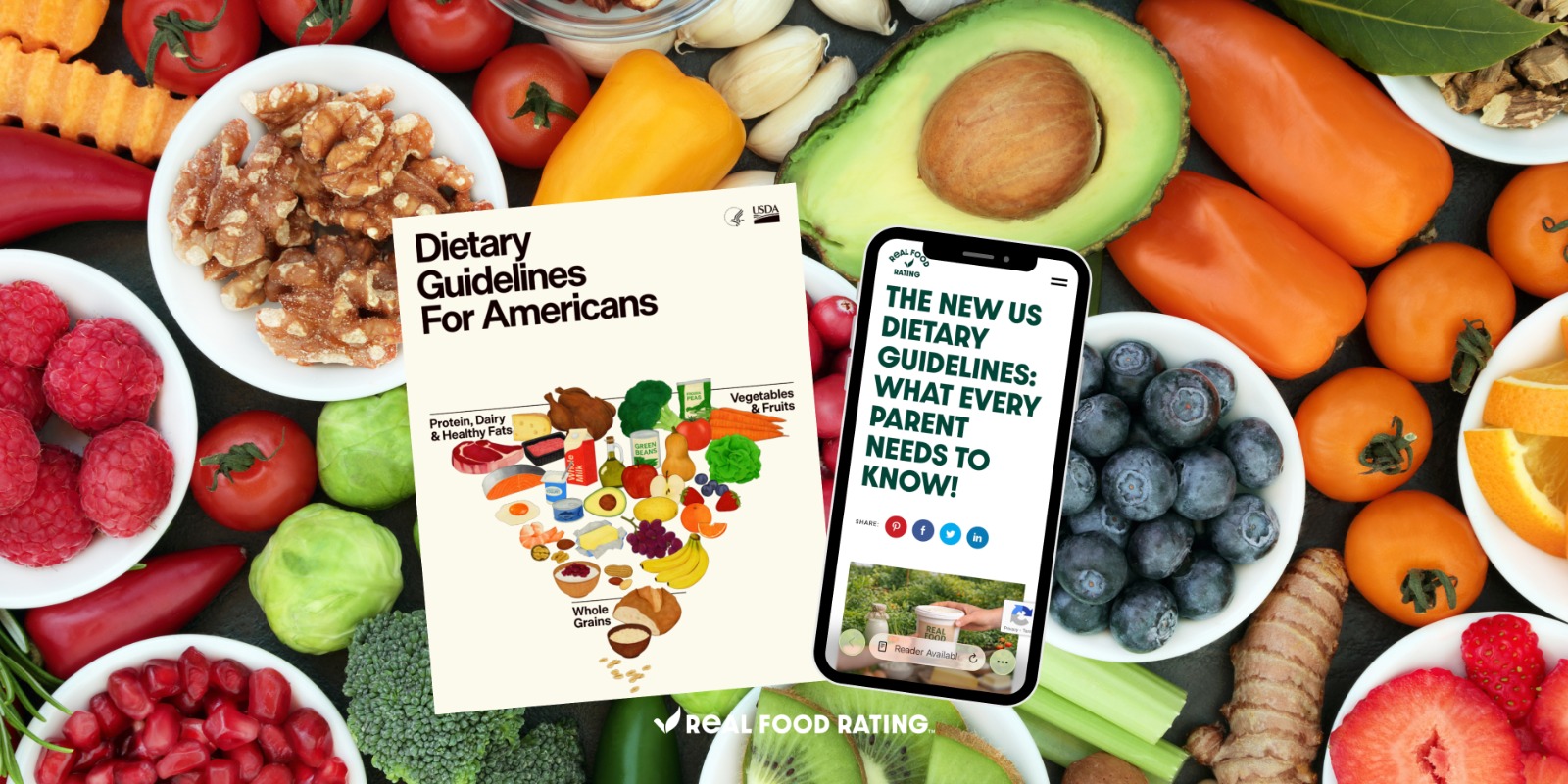
Last week, the United States released its 2025–2030 Dietary Guidelines and for the first time in the history of federal nutrition policy, the government explicitly told Americans to avoid highly processed foods. The message is blunt and 100% aligned with the Real Food Rating message: “Just Eat More Real Food.”
It’s a phrase that we have been saying for years, last year the Real Food Rating movement spiked and the media took notice but the government still hasn’t acted. So now, the harsh reality is that in America, it’s now official policy. In Australia, it’s still dismissed as fringe.
What Actually Changed in the US?
Let’s be clear about what happened, and what didn’t.
The wins are significant:
- Highly processed foods are named for the first time. The guidelines explicitly advise Americans to “avoid highly processed packaged, prepared, ready-to-eat, or other foods that are salty or sweet.” This isn’t buried in fine print. It’s a headline recommendation.
- No added sugar for children under 10. This is a dramatic shift. Previous guidelines recommended avoiding added sugars only for children under 2. The new guidance extends this to age 10, acknowledging what the science has shown for years: early sugar exposure shapes lifelong taste preferences and metabolic health.
- Real Food nutrition guidance for children. For children aged 5 to 10 years, the guidelines recommend diets centered on protein foods, dairy, vegetables, fruits, healthy fats, and whole grains, while avoiding added sugars and caffeinated beverages. Water and unsweetened beverages are recommended to support hydration.
- Protein is prioritised, not rationed. The updated guidelines recommend 1.2–1.6 grams of protein per kilogram of body weight, nearly double the previous recommendation, recognising the role of protein in satiety, muscle maintenance, and metabolic health.
- Full-fat dairy is officially rehabilitated. This is a major reversal. For decades, official guidance demonised full-fat dairy, pushing families toward reduced-fat products that are often more processed and higher in added sugars to compensate for taste. The new US guidelines recognise what the evidence has shown for years: full-fat, minimally processed dairy — think plain whole milk, cheese, and yoghurt — can absolutely be part of a healthy diet. The fat isn’t the problem. The processing is.
- Clear no-nonsense nutrition advice for babies. During complementary feeding, infants should be introduced to a variety of nutrient-dense foods in developmentally appropriate textures, while avoiding nutrient-poor and highly processed foods.
Here are my top yoghurt choices for Ausralian families.
It’S Still Not Perfect – There iS Still a Gap.
While the US guidelines now urge families to avoid “highly processed” foods, there is still no formal definition of what that actually means. Regulators have acknowledged the need for greater clarity, but families are left asking a very practical question: which foods count? At Real Food Rating, that work has already been done. Our system classifies thousands of ingredients by processing level, from whole and minimally processed foods through to ultra-processed additives, so families can see exactly where a product sits, not just whether it passes a vague or undefined threshold.
It’s the practical tool the US guidelines are still missing…and one Australian policy has yet to provide.
From the Real Food Rating perspective, this isn’t about an extreme pendulum swing from one ideology to another. Should meat be prioritised over vegetables? From a Real Food perspective, vegetables are still the winner but the focus shouild always be about balance, moderation, and simply eating more foods in their natural form.
Whether that’s legumes, nuts and seeds, or animal protein, each individual has unique dietary needs, cultural preferences, and health considerations. But whatever you believe, one thing is now clear: choosing real forms of protein over processed meats, hydrolysed soy protein, soy isolates, and ultra-processed “fake foods” is officially the direction of travel. The era of engineered protein substitutes getting a free pass is over.
So Why DoeS ThiS Still Matter for AuStralian FamilieS?
Because even an imperfect step forward is a step. The US has now officially acknowledged that how food is made matters, not just what nutrients it contains.
Australia hasn’t.
AuStralia’S GuidelineS: Frozen in 2013
Australia’s national dietary advice — the Australian Dietary Guidelines and Eat for Health resources — was last comprehensively updated in 2013.
That’s before the term “ultra-processed food” entered mainstream scientific discourse. Before the NOVA classification system gained international traction. Before landmark studies linked ultra-processed diets to increased rates of obesity, cardiovascular disease, depression, and early death.
In 2013:
- Instagram was two years old
- The iPhone 5 was new
- “Netflix and chill” wasn’t a phrase yet
Our dietary guidelines are from a different era, and it shows. The government’s Health Star Rating System still ignores processing and additives and rewards ultraprocessed foods with high Health Star Halos.
Here’S What AuStralia’S Current GuidelineS Don’t Do:
They still tell families to choose “mostly reduced-fat” dairy — advice that has pushed parents toward flavoured low-fat yoghurts loaded with sugar, skim milk that children won’t drink, and processed cheese products marketed as “lighter.”
Meanwhile, the evidence has moved on. Full-fat, minimally processed dairy is associated with better metabolic outcomes in children, not worse.
But Australian families following official advice are still skipping the plain Greek yoghurt and reaching for the strawberry-flavoured, fat-reduced, sugar-added alternative, because that’s what the guidelines imply is healthier.
Here’s the truth: the low-fat dairy message is outdated. It was based on the assumption that dietary fat drives weight gain and heart disease. That assumption has since been challenged by decades of research showing that whole, minimally processed dairy (plain full-cream yoghurt, cheese, milk) doesn’t carry the risks we were warned about, and may actually be protective.
Parents, it’s time to feel confident choosing natural, full-cream dairy for your family. Plain Greek yoghurt. Full-fat milk. Real cheese. These aren’t indulgences — they’re whole foods.
If you have specific medical concerns, absolutely discuss them with your GP or an accredited nutrition professional. But for most families? The science is clear, even if Australian guidelines haven’t caught up.
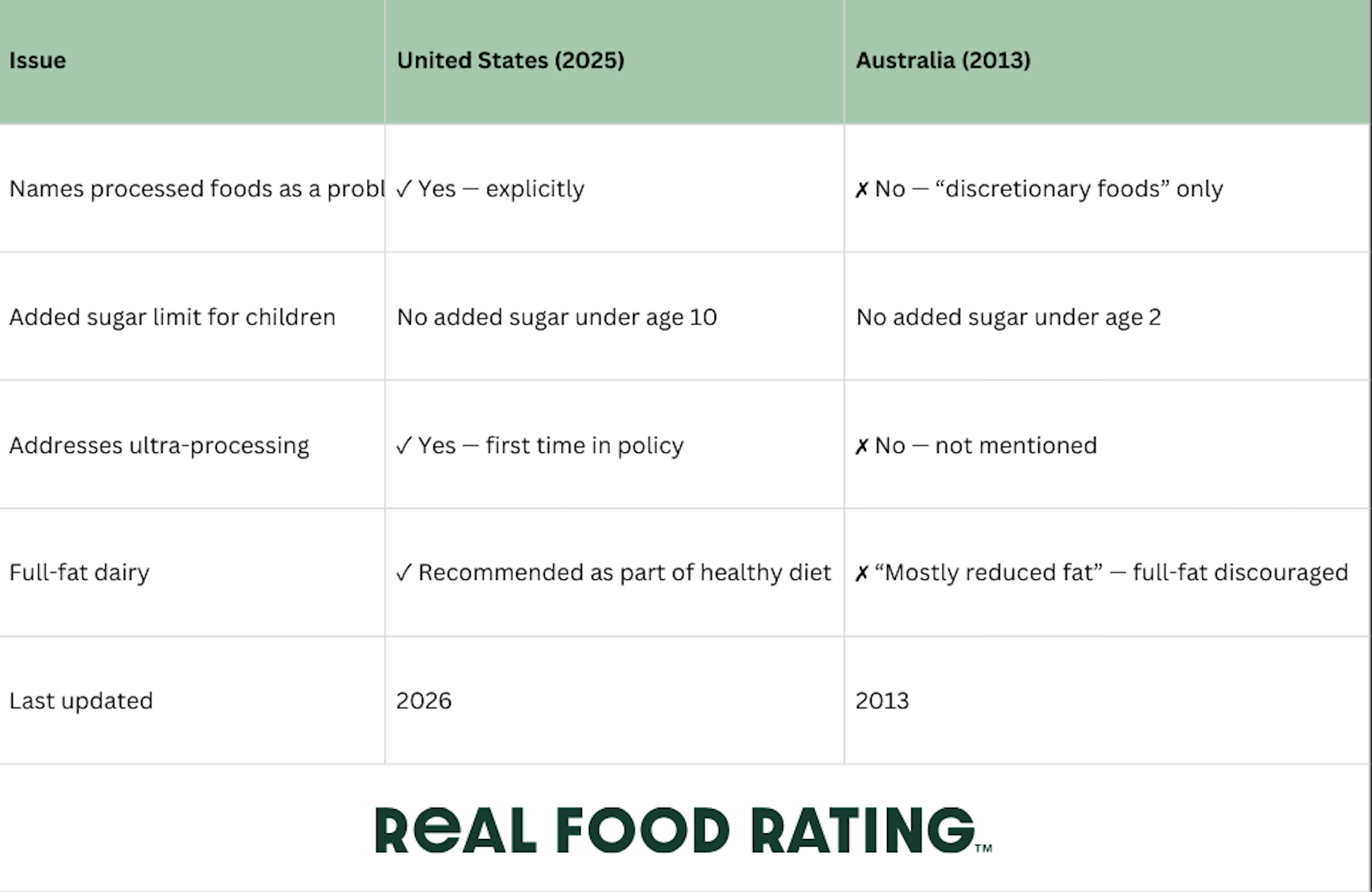 Australian families are navigating a food environment that has transformed beyond recognition — armed with advice that predates it.
The Gap, the Real Food Rating WaS Built to Fill
The Real Food Rating exists because Australian policy hasn’t kept pace with the science — or the supermarket.
While governments debate definitions and industries lobby for loopholes, parents are left to interpret labels on their own. Health Star Ratings, Australia’s front-of-pack system, were designed with input from the very food manufacturers now facing lawsuits overseas for misleading health claims.
The Real Food Rating was built on a different foundation:
- Processing matters. Not just nutrients in isolation, but how food is made, what’s been added, and what’s been stripped away.
- Transparency over marketing. No health halos. No “better for you” spin on reformulated junk. Clear information about what’s actually in the product.
- Children first. The developing palate, the growing body, the formation of lifelong habits — these aren’t afterthoughts. They’re the starting point.
What the US has now acknowledged at a policy level, the Real Food Rating is working with Australian families to provide a clear and practical tools to empower them to make the best choices for their families.
What ThiS MeanS — and What ComeS Next
The US guidelines aren’t a model to copy wholesale. And no government guidance will ever replace individual judgment.
But the direction that the US policy is moving in is timely, and Australia should follow suit.
Ultra-processing is no longer a niche concern; it’s a policy priority in the world’s largest economy. Added sugar in childhood is no longer a matter of moderation, it’s a recognised developmental risk through age 10.
Australia can continue to lag behind, clinging to guidelines that predate the problem. Or it can catch up.
In the meantime, Australian families don’t have to wait for policy to protect them.
The Real Food Rating gives Australian families what government guidelines don’t: a practical, transparent, science-informed way to navigate the modern food environment.
Join the Real Food Rating Community for news about the App launch, which helps shoppers see through the marketing hype.
Sign the petition. Demand clearer food standards in Australia
The Real Food Rating is an independent, parent-led initiative providing evidence-based food transparency for Australian families.
Coming Soon: The UnfuSSy EaterS Club
If you’re ready to build better food habits all year round, my new book The Unfussy Eaters Club launches in March 2026.
It features over 100 sugar-free, whole-food recipes and a dedicated “Special Occasions” section that shows how to celebrate birthdays and special occasions – without the additives.